Waves Tune Reading Notes From Wrong Octave
 Learning the ins-and-outs of how to tune your musical instrument and knowing the differences between each ukulele tuning is one of the well-nigh important things to work on when you're first.
Ensuring you are in the correct ukulele tuning volition make a world of difference in what comes out of the ukulele. If it'south off just a fiddling bit, music you play won't sound very nice.
Basics
What are the four strings of a standard ukulele tuned to?
A uke is usually tuned: G C E A from the top cord (closest to the ceiling) to the bottom string (closest to the flooring).
I tell my students who take a difficult time remembering this to think of it like, "Thouoats Can Eastat Anything."
Each string is numbered for easy reference. The Thousand-string is called the fourth cord. The A-string is called the 1st string. The C and Eastward-strings sit down respectively between.
This can seem backwards at first so just recall of information technology like the stories in a building.
1000 - 4 C - three E - 2 A - i
The Thousand-string can either be a "loftier-chiliad" or a "low-G".
A high-g is traditional and is tuned to the G above center C (called "re-entrant"). This makes the strings sound loftier-low-higher-highest – "my domestic dog has fleas."
A low-G is a more gimmicky sound and is tuned to the G below middle C which keeps the string in an ascending order: low to high (chosen "linear").
The interval distances between the strings are: a perfect 4th (One thousand to C), a major 3rd (C to E), and a perfect 4th (Eastward to A).
Ukulele Tuning Methods
There are several unlike ways you can tune your ukulele. Each has its pros and cons and can be used in different situations.
Learn ane that will aid y'all in everyday playing and become your go-to method for ukulele tuning, but also study the others so you accept options and alternatives in case your tuner breaks.
How to Tune Your Ukulele With an Electronic Tuner
The easiest method of tuning your ukulele is to utilize an electronic tuner. This is the simplest, most cinch way to tune for beginners.
There are three types of electronic tuners: clip-on, app/"listening" tuners, and pedal tuners. All work in a similar fashion.
A clip-on tuner clamps onto the headstock of your ukulele and "feels" audio vibrations. This allows y'all to tune in a roomful of dissonance without any trouble. These are the most pop kind of tuner due to ease of use and practicality.
I use a Planet Waves NS Micro. It's amazingly pocket-sized and authentic.
The alternative is an app on your smartphone device or a dedicated tuner with a microphone. Both work similarly by listening to the pitch (so it can be troublesome to tune if you're in a loud room), but an app is so much more convenient that information technology makes sense to become that route instead of a bulky defended tuner.
I apply the Boss Tuner on my phone. Information technology'southward free, accurate, and unproblematic.
A more professional tuning option is a pedal tuner that you plug your ukulele into. This is usually only applied if yous are using an amp and have another pedals. But it'south very accurate and works independent of noise similar a clip-on.
Stride 1: Preparing the tuner
To get started, clip the tuner onto your ukulele, place it somewhere close to soundhole and so that the microphone can pick up a strong audio, or plug your uke into information technology.
The readout style for all electronic tuners is pretty universal. But selection a string and the annotation is displayed on the tuner.
If the needle floats to the left, the displayed note is flat and needs to go higher in pitch (the string needs to be tightened).
If the needle floats to the correct, the displayed note is abrupt and needs to be lowered (the string needs to be loosened).
If it's expressionless center, the string is in tune.

Right Tuner Settings
Many tuners these days come with lots of options and settings that can be very confusing at offset.
Some tuners accept guitar, uke, and chromatic modes. The guitar and uke modes limit the display range, just showing those notes in the tuning. This means if your K-cord is at an F# note, the tuner shows "Chiliad," which is the closest in pitch.
To me this is disruptive, which is why I prefer to set my tuners to the chromatic setting. This way I can come across all the notes and always know exactly where I'm at on the spectrum.
The reference pitch is also usually adjustable. Unless you have a really good reason for irresolute it and know what you're doing, this should always be set to 440hz.
Melody the 1000-string
Pluck the G-string (the one closest to the ceiling) and look at the tuner.
If it says "G," you're close to the correct annotation and tin just suit the tuning peg and follow the indicator needle upward or downward until it's right in the center.
If it says something other than "G," y'all have to appraise whether the note is college or lower than M. Every annotation sits in the centre of a chromatic scale that radiates outwards infinitely. It looks kind of like this (just a small portion of it):
...E - F - F#/Gb - G - Grand#/Ab - A - A#/Bb... Your goal is to get the needle centered on the G annotation, simply sometimes if your uke is actually off, you'll take to tune through a number of these other notes before yous get to Chiliad.
If you lot see: D, D# or Eb, E, F, F# or Gb, try tuning Upwardly.
If you see: Chiliad# or Ab, A, A# or Bb, B, C, endeavor tuning DOWN.
Once you move the cord far enough, you'll see the note name change and the needle jump to the reverse side of where it was. This is considering the high pitch of one note is the low pitch of the next note, and vice versa.
This is the hardest part of learning to tune.

Be cautious with how tight you air current the strings. If you end up tuning the cord manner higher than information technology's intended to be, it can snap. Not merely is this painful if it hits your hand, but you usually won't be able to reattach information technology and yous'll have to buy new strings.
Utilise your judgement and if you lot think the string might be too tight, melody downwards until you get the note yous were looking for. If at this signal the string sounds bad and seems extra flabby, you lot were probably on the correct track to begin with and should go support the octave.
Nix bad will happen if you detune too much.
Tune the C-string
Tuning the C-cord of your ukulele is near exactly the aforementioned as tuning the Thou. The only divergence are the surrounding notes you might encounter. If you're already on C, great – just follow the needle. But…
If you see: G, Ab or G#, A, A# or Bb, B endeavour tuning UP.
If you meet: C# or Db, D, D# or Eb, E, F try tuning DOWN.

Tune the E-string
Again, the E-cord is more often than not similar, but at present you are reaching around the underside of the headstock. So be extra mindful of the management you are turning the peg.
Instead of E…
If you lot see: B, C, C# or Db, D, D# or Eb try tuning UP.
If you lot see: F, F# or Gb, Thou, Thousand# or Ab, A endeavour tuning DOWN.
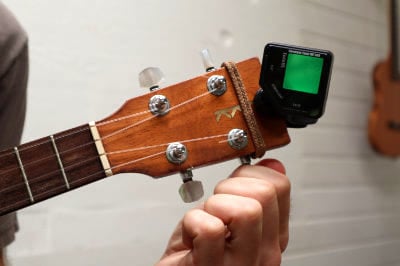
Tune the A-string
I more to go! Same verbal thought, just now you're on the concluding peg.
Instead of A…
If you lot meet: Eastward, F, F# or Gb, Chiliad, G# or Ab try tuning Upwards.
If you run into: A# or Gb, B, C, C# or Db effort tuning Down.

Recheck the tuning
Many times (particularly when you're starting out and going slow) you'll find that the first strings you tuned accept drifted off pitch past the time you cease tuning the last string.
All you need to exercise is quickly repeat steps 2-5 to bring everything back into tune. If you lot continue to have trouble with the strings slipping out of tune, cheque the section on why won't my uke stay in tune?
Play!
That's it! become forth and play music on your freshly tuned uke!
Information technology may seem painfully ho-hum to tune your ukulele at first, but once you get the hang of it yous'll exist tuning much, much faster.
Relative Ukulele Tuning:
The old-school way of tuning (and arguably best) is to pitch the strings relative to each other. You lot employ your ear to lucifer the pitch of one string to the adjacent.
This often yields a sweeter tuning because it volition be adjusted to what sounds best to your ears.
Tuning relative is fine if you are playing by yourself, merely if you endeavor to jam with your friend, you might notice that your "my domestic dog has fleas" will be college or lower than his/her "my canis familiaris has fleas."
A clever person would start by tuning 1 of his ukulele's strings to that of his friend'south so tune out from there.
I recently did a whole alive lesson well-nigh how to melody past ear:
Here'south how to melody your ukulele relative to itself. You tin approach it several ways, just this is the nearly common:
Tune everything to your bottom A string. If y'all are going to use a reference pitch, be certain you tune your A string to it.
i. Agree the fifth fret of the E-cord. This should exactly match the audio of the open A-string. Play both Eastward and A-strings simultaneously and conform the E-string'southward tuning peg until it's the same pitch every bit the open A string.
With geared tuners, turning the peg clockwise will loosen the string. Turning counter-clockwise will tighten it. This is true for standard or slotted headstocks.As long equally you are looking down the tuning peg the orientation will be the same.
With friction tuners, turning the peg clockwise for the top ii strings and counter-clockwise for the bottom ii strings will tighten the string.
2. Now concur the fourth fret of the C-cord. This should exactly match the open up E-string. Play both C and East-strings and suit the pitch of the C-string so that information technology matches the pitch of the open E-string.
3a. If y'all have a loftier-k string:
Hold the 2nd fret of the G-string. This should exactly lucifer the open A-string. Apply the ukulele tuning pegs to conform the pitch of the G-string so that it matches the pitch of the open A-string.
3b. If you melody your ukulele with a low-G string:
Concord the fifth fret of the G-string. This should exactly match the open C-string. Utilise the tuning pegs to adjust the pitch of the Thou-string and then that it matches the pitch of the open C-string.

When you play two of the same notes simultaneously (like the fifth fret, E-string to an open-A) and they are a bit out of tune, there is a "chirapsia" sound that happens. It's like a pulse; kind of hard to hear.
The further the two notes are out of tune, the faster and more than noticeable the beating sound. If your two notes are perfectly in tune, it goes abroad.
You tin can mind for this to get your unison notes very close in pitch, but information technology takes some practice.
Tricks for fine-tuning past ear
By verifying your tuning several unlike ways you tin go the strings even closer to the proper pitch.
1 of my favorites is playing the octave C with the open C-string and 3rd fret, A-string and also the octave G on the G-cord and third fret, E-cord. If yous play high-g your octave Yard will be a unison, but volition serve the same purpose.
Since you are skipping a string you have a risk to get the overall temper in tune better. If you tune to the A-string and work up, whatsoever error is reflected in the following string. By cross-checking the tuning in this way you can eliminate the possibility of these long-range, accumulative errors.
Another flim-flam is to play harmonics on the two outside strings on the 5th and 7th frets. By matching these two high pitches you can hear the chirapsia effect discussed above better.
Why Won't My Ukulele Stay in Melody?
A mutual problem beginners have when trying to tune their uke is that it simply won't stay on pitch.
This is frustrating considering even though you get the string to the right note, you lot can't play whatever overnice-sounding music for very long – or at all – because it quickly goes out of tune.
It IS normal for an ukulele to drift out of tune if you:
- Haven't played information technology in a while
- But changed strings
- Simply switched environments (temperature or humidity)
Some ukuleles but stay in tune meliorate than others.
I had a depression-budget Hula Ukes ukulele that I had to tune all the time. My Moore Bettah on the other manus rarely goes out of tune. Instrument stability has equally much to with it equally the strings. If you accept a uke that has joints and parts that shift around when the temperature changes, naturally the strings volition migrate out of tune.
Stock/Incorrectly Installed Strings:
A huge percent of the time, strings slipping tin can be attributed to wrong installation.
On budget ukuleles, strings are almost always installed hastily (time = money). This usually manifests in one of two ways:
- The string doesn't exert plenty friction on itself and actually slides through its pigsty in the tuning peg.
- The string is wrapped effectually the tuning peg many more than times than it needs to exist and extra slack hidden in the winds slowly releases over time.
Unless you are on a very tight upkeep, I always recommend replacing stock strings ASAP to avoid these problems. You'll also find that new strings sound better than their counterparts that have been sitting in a warehouse for months or years.
They Need to be Stretched:
New strings or strings that are afflicted by #2 to a higher place often need to take the slack stretched out of them.
More about pre-stretching strings.
Slipping Pegs:
Friction tuning pegs that stick straight back from the headstock ofttimes loose their grip on the hole they alive in. This leads to endless down-tuning that's caused by the peg actually turning in its hole.
Nearly friction pegs have a spiral on the dorsum that you tin tighten with a screwdriver. Adapt this small amounts at a fourth dimension until the string stops falling flat.
Over-tighten the screw and it volition be hard to plough the peg at all!
A popular alternative to traditional friction pegs are Gotoh planetary geared tuners. They preserve the look of the straight-back style, but have a four:1 ratio for more than precise tuning and are less prone to slipping.
Proper Tuning Technique:
The manner you arroyo getting your strings to pitch has a lot to do with how well the uke stays in tune.
You always want to melody up to the desired note.
This prevents unwanted slack from being trapped between the nut and tuning peg. Since a nut slot isn't a perfectly glace surface, the tension difference between the reverse side of the string and the side that y'all play on are rarely equal.
If you tune downward to a note, the tension of the long, ringing length of cord will be higher than that of the brusque, unplayed portion. Equally you play, the weight of your fingers on the frets will fifty-fifty out the tension between both sides of the string, causing information technology to go apartment.
Ukulele Tunings:
Depending on where you are in the world, there are unremarkably ii primary ukulele tunings:
Standard (GCEA) and baritone (DGBE).
A tuning can as well be named by the chord information technology is fabricated up of. Since the notes of GCEA make a C6 chord, standard ukulele tuning is often chosen "C6 tuning."
Baritone tuning is the same as standard, simply it'due south tuned down a perfect fourth lower to a G6 chord. This is the same as the lesser four strings of a guitar.
The other main variant is the D6 tuning. This tuning is A D F# B and is a whole step higher than standard. It's common in England, only besides in Canada where D6 is the tuning often taught in schools.
Any ukulele can exist tuned to almost any tuning, merely y'all have to exist careful with the gauges of strings you utilise.
According to D'addario, a standard high-m tenor set tuned to G C Due east A exerts 49.61 pounds of tension on the ukulele. Changing the tuning upwards to A D F# B jacks the tension upwardly to 62.62 pounds – a 23% increase.
This is playing with fire in my book then a tool like String Tension Pro is invaluable for figuring out safety tensions beyond different tunings and scale lengths.
Alternate Ukulele Tunings
Slack Key
An open up-C slack-cardinal tuning is really the only variation that has whatsoever kind of following. It's prissy because a directly barre across the fretboard becomes a major chord. This makes it easy to play certain Hawaiian style runs with.
You lot can tune whatever ukulele to slack key without changing strings. Simply lower the pitch of the A-string a whole step down to Yard.
One-half Pace Downwardly
I've been playing solo a lot recently and usually roughshod like my sound is thin when playing in standard tuning. Information technology IS only a uke and a voice, afterwards all.
So I began looking around for alternative means to audio "bigger." It occurred to me that many of the great guitarists tune downward a half step to Eb. On an ukulele it's a B6 tuning: F# B D# Grand#.
The moment I tried this on ukulele I knew I was on to something. The audio was fatter and had a nice deep ring to information technology. Information technology really brought out a nighttime vibe in my ukulele that I actually liked the audio of. And it sounded more ballsy on its own.
More nigh tuning downward a half-step.
Octave-Down on a Baritone
Simply out of marvel I put the bass strings from a heavy classical guitar set on my baritone ukulele and tuned it to low-GCEA, but an octave lower than standard pitch. The results were interesting, as you tin hear for yourself:
Tuning Ukuleles With Boosted Strings
When an ukulele has more than 4 strings things can get confusing really fast.
For more on ukuleles with doubled courses like 5, 6, and eight-string ukes, bank check out my in-depth tuning guide specifically for those tunings.
Tuning five, 6, and viii-Cord Ukuleles
Guitalele: depression-A – low-D – low-G – C – E – A. Tuned like guitar with a capo on the 5th fret.
Source: https://liveukulele.com/lessons/tuning-your-ukulele/
0 Response to "Waves Tune Reading Notes From Wrong Octave"
Postar um comentário