Revit Change Orientation of Model Pattern in Imported Family
I have been working on a Revit implementation and only discovered by accident that you can include dimension parameters that deport like reporting parameters in the labels of Generic Annotations. While very intrigued, I have not come up up with a really practical use of this yet.
For those of you non familiar, let me take a few moments to explain Generic Annotations. For the AutoCAD users, a Generic Note Symbol in Revit is basically a block with attributes from AutoCAD. In other words, it is a simple symbol with user editable text field(s). The prissy matter about these is that the text fields tin receive basically whatsoever input you like and y'all can even schedule all the values in a "Note Block" schedule. For the BIM purists, Generic Annotations are Non very "smart." This is considering the information is non being reported from the model like a normal tag, rather the information lives in the fields of the Generic Annotation object itself. Nevertheless, smart or not, they have their uses and in some cases can be merely what you need in your documentation efforts.
There are some unfortunate terminology hurdles to overcome when using them however:
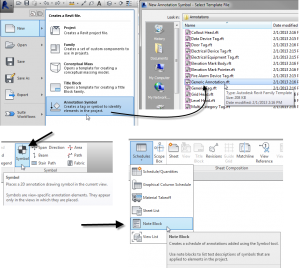
- To create a new Generic Annotation family, use the Generic Annotation.rte family template. (Application menu>New>Annotation Symbol). Practice not modify the category.
- To place a Generic Annotation family unit in your projection, use the Symbol tool. (Annotate tab > Symbol console > Symbol tool).
- To schedule the values you lot input in the fields, create a Notation Cake schedule. (View tab > Create console > Schedules drop downward > Note Block).
Got information technology? The family is a Generic Annotation, the tool is Symbol and the schedule is Note Cake. Weird.
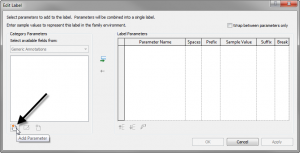
When creating the Generic Annotation, if you want to have fields, add a Label like you lot would in any annotation family. When you practice, the listing volition announced empty. This is because we left the category set up to Generic Annotations. This is what we want. At the bottom left corner of the dialog, you tin add together custom parameters to the symbol. These volition become the fields that nosotros can edit. Click the Add Parameter icon, configure the parameter as y'all like, usually a Text parameter so that you tin can type in anything y'all desire. However, in some cases yous may want Number or Integer. Add it to the label. You can add as many equally yous like.
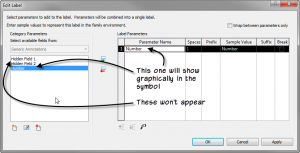
A really interesting tidbit here. Y'all can add several additional parameters beyond what you need to announced in the symbol. In other words, y'all can add together "hidden" fields. Any parameters that you add simply exercise not include in the label on the right volition nonetheless be able to receive values in the project and more importantly, will still appear in the Note Block schedule! But add the parameters, but do not put them in the label at the right. When you OK out of the dialog, y'all can add some graphics like a circumvolve or hexagon if you like.
OK, so far so good. Yet, none of this is new. Nosotros accept been able to practice this for quite some time in Revit. Here is the part I just discovered. I wanted the circle to be parametric: I wanted to be able to flex the size of the circle. So I drew the circle, added a diameter dimension and then labeled the dimension with a family parameter that I chosen D.
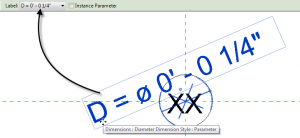
Now the actually interesting part. Create another label (Create tab > Text panel > Label button).
Observe that you tin can add the dimension parameter D to the label! This basically means that the symbol volition be able to tell you how big it is!!!
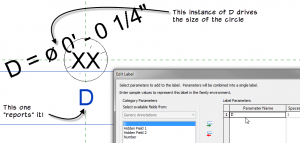
So D is now both a driving and a reporting parameter. Very cool! Let'southward test information technology out. Save the family, load it into a projection and place a few.
To edit the visible fields, y'all can click correct on the symbol. To edit the invisible fields, use the Properties palette. Go ahead and create a Note Block schedule to listing them all. Sort and grouping it how you similar.
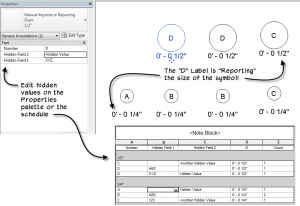
Annotation families are very useful. They are view-specific, suit with the scale of the view and can be embedded in other families. All of the Revit tags and symbols are annotation families. But ONLY generic note families (Symbols) can study to Note Block schedules. They are useful for those cases where a truthful tag volition not work, like sure types of finish note or other very specialized documentation.
I am not certain if this little "reporting parameter" behavior I stumbled on here will prove useful in a practical sense. But you can bet I volition be exploring it further.
Have you found a applied employ for this? Post in the comments, I'd love to hear virtually it. Cheers!
Hither'southward a file with a sample.
Source: https://paulaubin.com/blog/generic-annotations-in-revit/
0 Response to "Revit Change Orientation of Model Pattern in Imported Family"
Postar um comentário